e621.net · 5793785
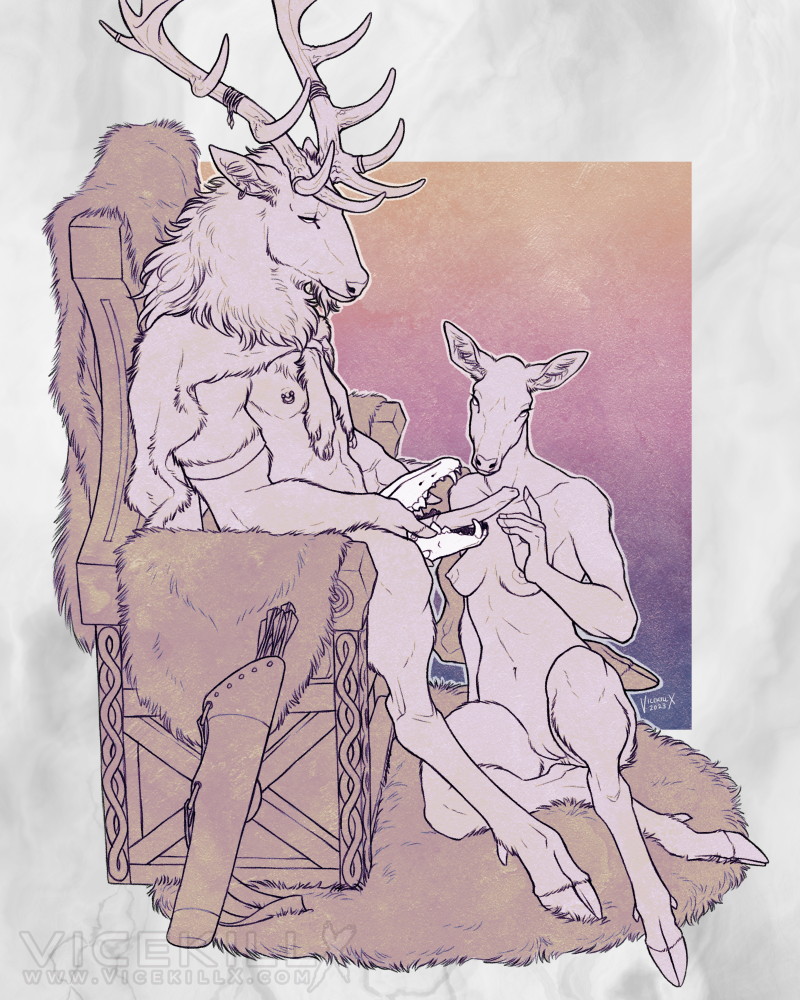
h4.The Ritual II (by SpartaDog)

Another fantastically realised commission idea by the wonderful and highly talented artist Spartadog

This is a continuation of the Commission "The Ritual":/posts/5793783/ - supplemented by a little story, which should bring the background of this idea closer.
The world-building continues in "The Ritual III":/posts/5793786/ with a character-driven story.

~~~֍~~~☼~~~֍~~~☼~~~֍~~~☼~~~֍~~~☼~~~֍~~~☼~~~֍~~~
[section=Story]

[b]Populi Aquilonis (The Peoples of the North)[/b]
A field report by Lupus Montis Oliveti, former commendant of the Surrian camp 'Castellum ad radices montium'.

"Dense, dark and threatening are the forests of the North....
And like the nature in which they live, their peoples also seem wild and dangerous.... Capable of reason, but in their behaviour and way of life more similar to their four-legged counterparts than to the civilised anthros in the cities of the south.

Their gods are trees, stones and animals... their language as rough and harsh as their appearance... and even the herbivores among them wear skins or clothing made of leather from slain animals, unless they walk directly naked through their settlements.
This book is intended to paint a picture for the Anthros of Surr of the dangers and wonders that await beyond the mountains to the north.... be they traders, soldiers or colonists who may seek their fortune in the still unexplored expanses.

[b]Chapter I - Herutak: The Deer People[/b]

[b]Appearance[/b]
One of the most visually impressive peoples are the Herutak... the Deer-Anthros. At about 2.10 metres - not counting the antlers - the Herutak males exceed even the deer peoples in the provinces south of the mountains... and their females are also imposing, averaging 1.85 metres.

With their reddish-brown to grey-brown fur, they seem to merge with the large, old trees of their homeland as they almost silently tread ancient paths of moss, leaves and earth in the shade of the treetops.
While the males wear antlers that can reach impressive size according to age and rank, the females lack this feature altogether.
For most of the year, the Herutak's clothing is functional and simple: if their dense fur already provides sufficient protection from the weather, they usually cover their genitals with cloths and loincloths made of linen. Only the higher-ranking males and females sometimes wear garments made of soft leather... or even skins of foxes, badgers, wolves and deer.

What may seem strange to us... Herbivores who themselves hunt predators and their four-legged counterparts in order to wrap themselves in their skins, underlines the ferocity of the Herutak.... And yet this behaviour is also explained by their customs and rites, as well as the roughness of their homeland, where the weaving of fine fabrics still seems to be largely unknown.

[b]Way of life[/b]
The Herutak live in tribes whose settlements rarely consist of more than 60 anthros. The central point of such a settlement is the longhouse, a wooden one-room building whose walls converge like roofs from the ground to the top. One or two fireplaces in the centre of the house serve as a source of light and heat in winter, and as cooking places where chestnuts are roasted or soups are cooked. Around this main house are several tents made of leather and linen of variable size, which can be cleverly dismantled within a short time and converted for individual purposes... for example as additional sun protection in summer or for the protection of berry bushes, mushroom gardens or seedlings, which the Herutak grow around their settlements as food sources. The keeping of livestock has not yet been observed in any Herutak settlement.

While many settlements seem to be located deep in the forests, there are also tribes that prefer the forest edges. These tribes are skilled in growing lush grass, linen and all kinds of herbs... some with healing properties, others with intoxicating effects when burnt as incense in rituals.

The exchanges between the tribes seem to follow fixed dates, which are determined by recurring events in nature... solstices, the seasons and the blossoming of trees considered sacred...
These meetings are usually accompanied by celebrations. Goods are exchanged as well as young adult females and males who leave their families as an alliance between the tribes.

Even though the Herutak prefer to stay among themselves, sometimes traders and emissaries of other peoples join such festivals and markets: Voks... the anthro foxes and the Skegha... Anthro-bighorn sheep, have been sighted as well as the Suwo... Anthro wild boars. They prefer to exchange their herbs, weapons, old antlers and skins with them for jewellery, as there seem to be very few among the tribes of the deer people who have mastered the art of ore processing and blacksmithing.

Meetings between Herutak and the Wulhwak... the people of the anthro-wolves, the Luhsak... anthro-lynxes and the Beror... Anthro-bears, on the other hand, remain a clear exception.
May everyone acknowledge the rationality of the other peoples, there are probably horror stories in every Herutak settlement of hard winters in which Wulhwak, Luhsak or Beror not only hunted the four-legged deer of the forest... At the same time, the predator peoples also insinuate that the Herutak do not only display skins and skulls of their four-legged likenesses in their longhouses.

According to my observations, the Herutak are more matriachally organised than it may appear at first glance to outsiders:
It is the females who own their permanent places in the longhouse... protected from the weather all year round. A leading stag doe, who bears the title 'Ledare', presides over the tribe as leader for most of the year and makes many decisions: when to hold festivals... When to meet with other tribes.... Who is accepted into the tribe or has to leave the settlement... which goods are exchanged... The final decision is always made by the hind.
The male Herutak live with their mothers until the end of childhood, before they - like most males - have to move to the tents, where they live either alone or in small groups of up to four anthros, and perform their duties for the tribe.

While the females are primarily concerned with gathering and cultivating food and sewing clothes, the males start early to measure their strength among themselves in ritual fights... Besides the fight stag against stag, this also includes learning how to use weapons such as bows and arrows, lances or daggers for hunting, which is only done by the males. Only a stag who has proven himself in both fighting and hunting can rise in the rank of the clan.
Only for about 3 months - from late summer to winter - does a male take over the leadership of the clan.

[b]Customs and rites[/b]
A central role in the life of the Herutak is played by the annual fertility festivals and their rituals. Even if this part of their culture seems strange to any civilised Anthro, it is especially during these rites that the strong connection to nature of this people stands out... the sexual life of the Herutak is strongly reminiscent of the rutting of their four-legged counterparts.

Already during the summer, the strongest stags of the tribe meet for ritual fights in clearings, which are watched with interest by the hinds. Whether a male is allowed to participate in these "rutting" fights at all is decided by his rank, which he has to earn through previous fights, successes in hunting and his position with the females. All those males who are not allowed or able to participate in these fights will also defend their settlement from attackers, strangers and marauding bachelor groups during the autumn.

Although these are ritual fights, the outcome can still end in serious injuries or even the death of the weaker one. It seems as if victory is the only meaning of life for all opponents, as the end of the fight decides which of the stags will be allowed to reproduce with all the sexually mature females of the tribe... this circumstance also explains the comparatively high mortality rate among the male Herutak. Death in battle, in the hunt or in defence of the clan does not frighten the stags, as they are convinced that they will be reborn and become stronger and more skilled with each new life.

The following descriptions are only based on stories that have been brought to my attention, since presumably no outsider has ever witnessed these sexual fertility rituals...

The winner of the "rut" fights is chosen as 'Harjak'... a temporary leader who makes the decisions of the tribe until winter. On the very day of his victory over the last challenger, a large tent is erected for him near the longhouse, which he decorates with the skins and skulls of the animals he has killed as proof of his strength and skill. Next to a sleeping place and a wooden throne, the younger stags set up fire bowls with lust-inspiring smoke, while the females drape the tent with comforting herbs.

It is the Ledare, the leading hind, who decorates the Harjak's antlers with ribbons, shells and rings of gold in front of everyone, before lower-ranking females rub his fur with essential oils.
With a loud, animalistic-sounding roaring song, the Harjak then initiates the rituals, which will last for the next few weeks...
With the end of the song, the lower-ranking males break down their tents to rebuild them in a wider radius around the longhouse and the "rutting" tent. Non of them is allowed to approach the tent during this time.... they will do their work and defent their tribe.... and continue to train, in the hope of perhaps ascending to 'Harjak' themselves next year.

And like the four-legged deer in the forest, the females gather around their new top stag.

The Harjak rarely leaves his tent during these weeks. It is the females who feed him with berries, grapes, chestnuts and beechnuts, while he mates several times a day with all the sexually mature females of the tribe, one after the other.
The Ledare always has the right of first intercourse.... She is also the one who usually chooses one to three inexperienced females from the tribe to witness this first act.... Holding fruits, oils and spring water ready to feed and clean the couple after coitus.

During these weeks, the Harjak has to prove all his virility. The females, who have prepared themselves for this ritus for a long time, are merciless with stags who do not withstand the sexual pressure... The very next year, such a stag can be barred from participating in the ritual fights again.
This form of ritual sexual selection has made the Herutak males very persistent compared to their four-legged counterparts. Instead of seconds, sex lasts up to twenty minutes and culminates... as with the four-legged deer, in a final "ejaculatory leap" in which the stag thrusts with all his might one last time as he shoots his semen into his female.

I could not find out whether this behaviour is also of a ritual nature and has been copied from the deer of the forest... or whether it is a physical peculiarity of the northern deer populations.

A behaviour no less strange for us civilised Anthro is the ritual worship of the Harjak's penis by the females. For this purpose, the Harjak presents his erected phallus to his female partners on the fur or between the jaws of a predator he has killed... The Herutak are convinced that in this way the strength and endurance of the animals will be passed on to their offspring. At the same time, this rite symbolises the Harjak's willingness to protect all females and their offspring from all dangers, even if he will relinquish leadership to the Ledare with the onset of the snowfall... to be ready for them again next year.
The females, meanwhile, can express their affection and willingness to support the stag next year by stimulating his penis.... However, should a Harjak be violent towards the females, or should the females otherwise feel disrespected by him, they would be able to make the teeth of the predator's skull snap shut.... and thus not only painfully end the "rutting season" for the Harjak, but also show him that he will not be allowed to fight again next year.

No disgrace seems greater for a Harjak than to be driven out of the "rutting" tent prematurely by the females in pain.

However, if the Harjak showed himself worthy, all the adult fertile femals of the tribe will be pregnant by him by the end of the fertility rituals. The tent is taken down and all the belongings in it are put back in the longhouse or the private tent of the HarJak in a chest. Still until the snow begins to fall, the Harjak remains in the longhouse on equal footing with the Ledare.... and calls the other males back around the longhouse with a roaring song, allowing them to pitch their tents again.

With a feast in the longhouse, those stags who return to the tribe after months of exclusion are also welcomed back into the community. Only a few try to join bachelor groups or even fight alone in other clans.. hoping to become a Harjak the next year.

And with communal chanting and ritual ablutions at one of their great sacred trees, whose branches are symbolised for the ancestors' antlers, the tribes end these rituals of fertility.... Also the females worship certain trees like deities.... I could observe how the femals of one tribe dyed their fur white with lime and drew patterns on it with charcoal until they looked like the birch trees, which for this tribe probably symbolised one of their goddesses.
In front of these trees, I was told, the hinds prefer to give birth at the beginning of summer...
The stags, on the other hand, lose their antlers in spring... This is also seen as a reminder to their goddesses to take care of the offspring and thus the future of the tribe, just like the hinds... until the rituals of battle and procreation begin anew with the regrowing antlers."
[/section]
~~~֍~~~☼~~~֍~~~☼~~~֍~~~☼~~~֍~~~☼~~~֍~~~☼~~~֍~~~

(Story by Steppenfire)
Comments
No comments yet.
Log in to comment.
e621.net · 5793785
did you just do a mass post? lol. i logged on and i get all of these on my fyp!