[quote]"clawstripe":/users/14014 said:
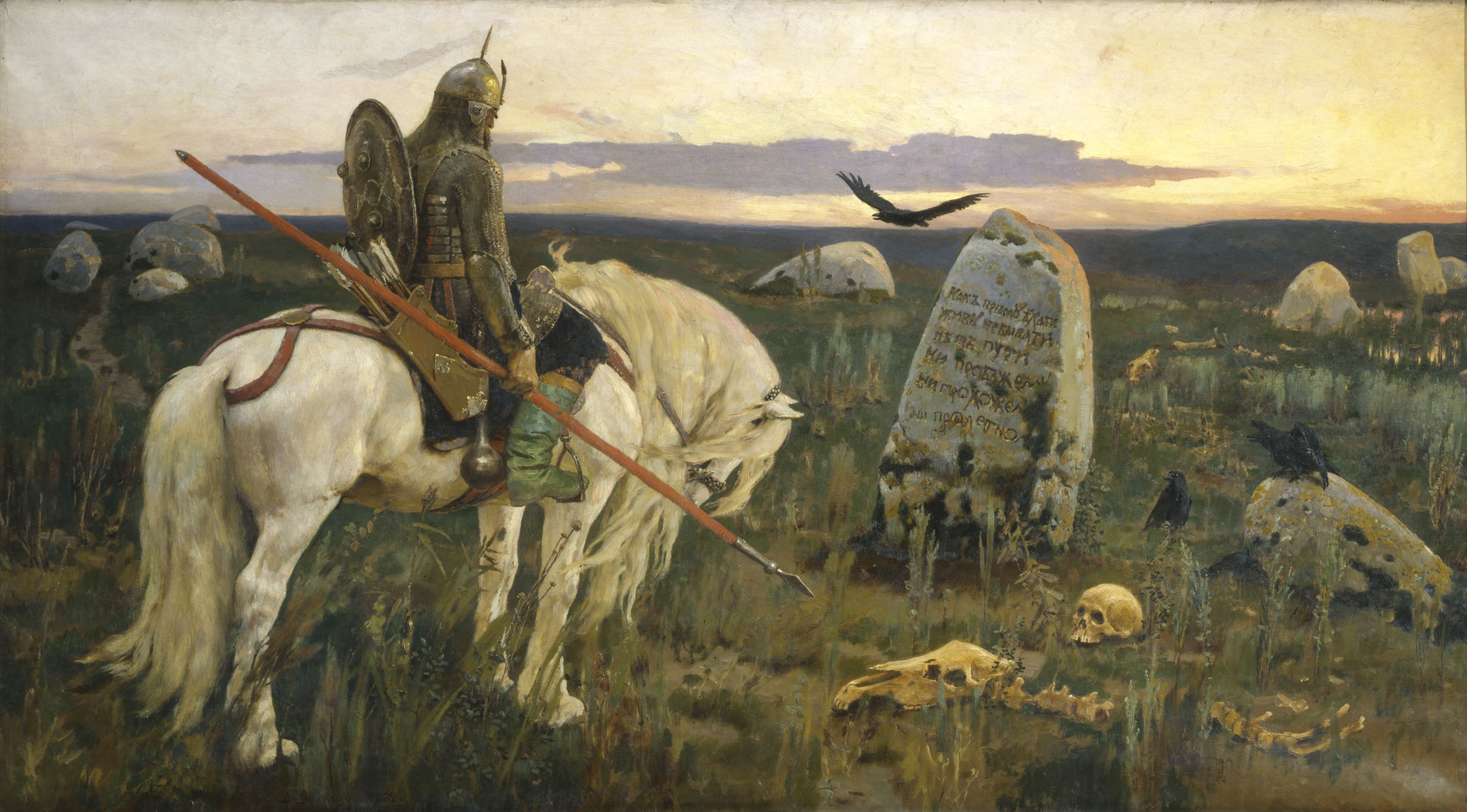
It seems this is a common motif in Russian folk tales. A knight would find himself at a fork in the road where he'd see a standing stone with an inscription on it that reads, "If you ride to the left, you will lose your horse; if you ride to the right, you will lose your head," or words to that effect. The implication is that he had a choice between two undesirable outcomes and had to choose between the two in order to continue his adventures.
[/quote]
My knowledge of Russian is a little limited, but I can somewhat read the inscription:
[i]Какъ прямоу ѣхати
Живоу нр[?]ывати
Нѣтъ пути
Ни проѣзжем[...]
Ни прохожем[...]
Ни пролетном[...][/i]
It's probably Church Slavonic since I recognize a few forms that are not present in modern Russian. I can't exactly translate it, though it seems to say something like:
[i]How to go straight forward [?]
I live [...]
No path [?][/i]
And then gives three 'alternatives' which I can't really understand, but they seem forms derived from verbs of motion.
Edit: of course I noticed that it had already been translated only after making the comment. Lol.
[quote]"clawstripe":/users/14014 said:
It seems this is a common motif in Russian folk tales. A knight would find himself at a fork in the road where he'd see a standing stone with an inscription on it that reads, "If you ride to the left, you will lose your horse; if you ride to the right, you will lose your head," or words to that effect. The implication is that he had a choice between two undesirable outcomes and had to choose between the two in order to continue his adventures.
[/quote]
Very interesting because this is different from the knights from what become england or spain that is tales of glory and the knights always gaining something in the tales
It seems this is a common motif in Russian folk tales. A knight would find himself at a fork in the road where he'd see a standing stone with an inscription on it that reads, "If you ride to the left, you will lose your horse; if you ride to the right, you will lose your head," or words to that effect. The implication is that he had a choice between two undesirable outcomes and had to choose between the two in order to continue his adventures.
Comments
No comments yet.
Log in to comment.
e621.net · 6172204
[quote]"clawstripe":/users/14014 said: It seems this is a common motif in Russian folk tales. A knight would find himself at a fork in the road where he'd see a standing stone with an inscription on it that reads, "If you ride to the left, you will lose your horse; if you ride to the right, you will lose your head," or words to that effect. The implication is that he had a choice between two undesirable outcomes and had to choose between the two in order to continue his adventures. [/quote] My knowledge of Russian is a little limited, but I can somewhat read the inscription: [i]Какъ прямоу ѣхати Живоу нр[?]ывати Нѣтъ пути Ни проѣзжем[...] Ни прохожем[...] Ни пролетном[...][/i] It's probably Church Slavonic since I recognize a few forms that are not present in modern Russian. I can't exactly translate it, though it seems to say something like: [i]How to go straight forward [?] I live [...] No path [?][/i] And then gives three 'alternatives' which I can't really understand, but they seem forms derived from verbs of motion. Edit: of course I noticed that it had already been translated only after making the comment. Lol.
[quote]"clawstripe":/users/14014 said: It seems this is a common motif in Russian folk tales. A knight would find himself at a fork in the road where he'd see a standing stone with an inscription on it that reads, "If you ride to the left, you will lose your horse; if you ride to the right, you will lose your head," or words to that effect. The implication is that he had a choice between two undesirable outcomes and had to choose between the two in order to continue his adventures. [/quote] Very interesting because this is different from the knights from what become england or spain that is tales of glory and the knights always gaining something in the tales
It seems this is a common motif in Russian folk tales. A knight would find himself at a fork in the road where he'd see a standing stone with an inscription on it that reads, "If you ride to the left, you will lose your horse; if you ride to the right, you will lose your head," or words to that effect. The implication is that he had a choice between two undesirable outcomes and had to choose between the two in order to continue his adventures.